It's Thursday evening, your Liverpool flat is empty for the weekend, and a request comes in for Saturday night only. One night, one couple, in town for a gig at the M&S Bank Arena. Do you take it?
Most hosts say yes without thinking, because a booking feels better than an empty calendar. Some say no on principle, because one-night guests mean a full clean for one night's money. We went back through every booking across eleven of the homes we manage and found that both camps are half right. Whether a one-night stay makes you money depends almost entirely on which night it is, and what's either side of it.
The short version: one-night bookings were 9% of our stays but only 4% of our revenue. Midweek, and in gaps between two other bookings, they were found money. On a Saturday, eleven of them came with an empty Friday next to them.
What we looked at
This covers the eleven properties we currently manage that appear on owner statements from December 2025 to April 2026: seven two-beds, a one-bed flat, a three-bed, a four-bed and a six-bed, from the city centre out to Anfield, Everton, Wavertree and the Wirral. That's 290 bookings, 925 nights and £115,139 in rental revenue, not counting cleaning fees.
Twenty-seven of those 290 bookings were for a single night. Together they earned £4,831: 9.3% of bookings, 2.9% of nights, 4.2% of revenue.
A one-night booking pays about the same per night, but there's only one night
The first surprise was that one-night guests didn't pay a premium. Their average was £179 a night. Two-night guests averaged £184. Same rate, half the stay.
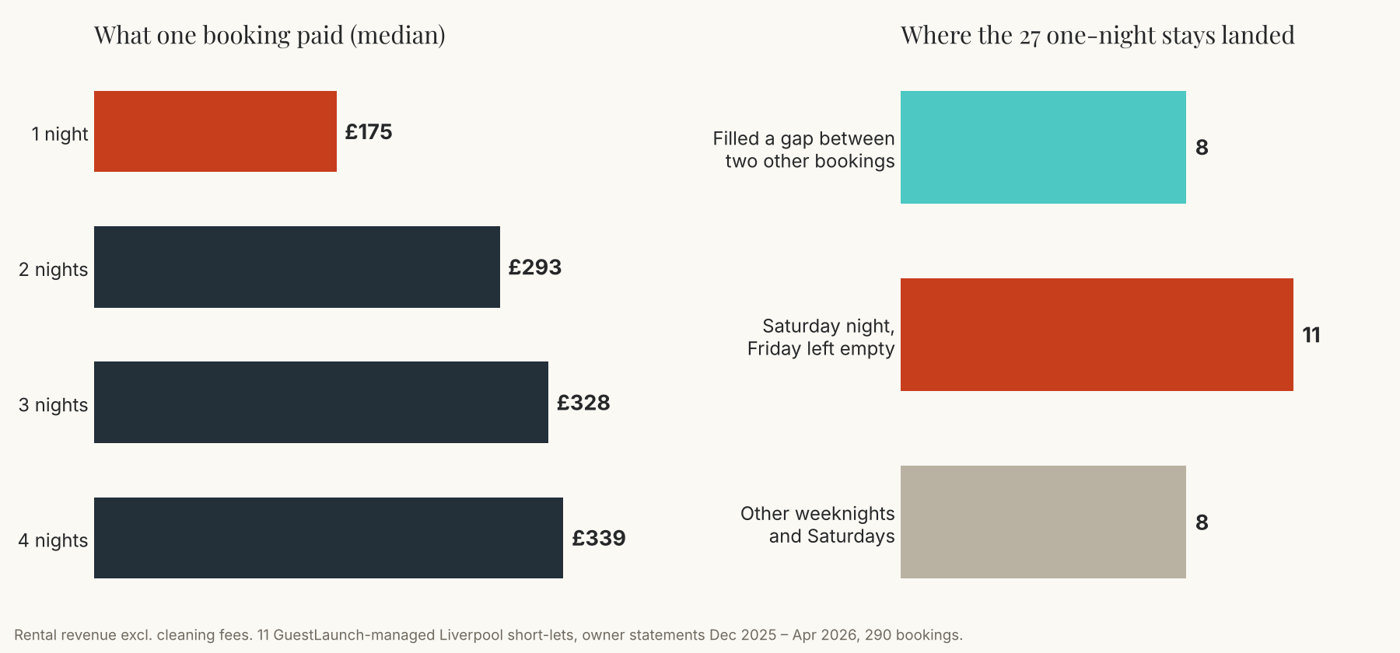
Per booking, that gap is wide. The median one-night stay earned £175. A two-night stay earned £293, three nights £328 and four nights £339. Every booking, however short, means a full turnover: linen, cleaning, restocking, a check-in, and another chance of something going wrong. A one-night stay asks the same of your cleaning team for a little over half the money of a two-night stay. (We broke down what each turnover really carries in our post on Airbnb cleaning costs in Liverpool.)
Guests did pay a cleaning fee on every one of those stays, a median of £75, the same as on two-night stays. So the clean itself was mostly covered. The real question isn't the clean. It's what else the booking cost you.
The good one-night stays: gaps and quiet weeknights
Eight of the 27 sat between two other bookings. One guest checked out, the one-nighter stayed, and the next guest arrived the following day. Those eight earned £1,337. Without a one-night option, those nights would almost certainly have sat empty: a single night trapped between two stays can't be sold to anyone who wants two.
These are what pricing people call orphan nights, and they're the clearest case for allowing one-night stays. Six of the eight were at our one-bed in the commercial district, a flat that lives on short, last-minute city stays.
Nine were midweek or Sunday nights (three of them also gap fills). Tuesdays, Wednesdays and a couple of Sundays, at a median of £139. Not exciting, but Liverpool weeknights are hard to fill in winter, and an empty Tuesday earns nothing at all.
The expensive one-night stays: Saturdays that strand the Friday
Sixteen of the 27 one-night stays were on a Saturday. That's where it gets interesting.
In eleven of those sixteen, the Friday night before was empty. The guest arrived on Saturday, left on Sunday, and the property sat unsold on Friday.
To see what that weekend could have looked like, we went through every weekend at the five properties that took one-night Saturday stays: 100 weekends in all.
| What happened on Friday and Saturday | Weekends |
|---|---|
| One booking took both nights | 54 |
| Saturday sold, Friday empty | 22 |
| Neither night sold | 15 |
| Both sold, to two different guests | 5 |
| Friday sold, Saturday empty | 4 |
Five Liverpool short-lets (two Anfield two-beds, a Ropewalks two-bed, an Everton two-bed and a commercial-district one-bed), every Friday and Saturday from December 2025 to April 2026. A one-night Saturday booking accounts for 11 of the 22 "Saturday sold, Friday empty" weekends.
More than half the time, these homes sold Friday and Saturday together as one booking. At those same five properties, a two-night Friday-to-Saturday booking had a median value of £375. A one-night Saturday booking had a median of £183, and its Friday went unsold.
We need to be honest about the limit of this data. Owner statements show when guests stayed, not when they booked. We can't prove that a two-night guest was out there for each of those eleven weekends, or that the Friday was still sellable when the Saturday booking came in. Some of those Fridays would have stayed empty whatever we did. But 54 out of 100 weekends selling as a pair tells you a Friday-and-Saturday guest is the normal Liverpool weekend booker, and a Saturday-only booking taken six weeks out shuts the door on them.
Not every property gets them
Five of the eleven homes took no one-night stays at all in five months: the six-bed and four-bed houses, and three of the two-beds. Twenty-two of the 27 landed at just three properties: two two-beds in Anfield and the one-bed in the commercial district. One of the Anfield flats took eight one-night stays out of 28 bookings, close to a third.
That pattern makes sense. Groups booking big houses come for weekends, not single nights. Small flats near the stadium and the city centre attract gig-goers, match-day visitors and people stopping over on business. If you own a small city flat, one-night stays will be a real part of your calendar, so the rules you set around them matter more for you than for anyone.
The minimum-stay rules we use
None of this needs a blanket "yes" or "no". Here's how we set minimum stays across the homes we manage, and why. This is the same thinking behind our occupancy-first pricing method.
- Two-night minimum on Friday and Saturday arrivals, set well in advance. This protects the weekend pair, which is what most Liverpool weekend guests want anyway.
- Drop it to one night in the last 10 days or so. By then, the Friday-and-Saturday booker has usually either booked or gone elsewhere. A late Saturday-only booking is now filling a night that would otherwise sit empty, not blocking a better one.
- Always allow one-night bookings on orphan nights. Pricing tools such as PriceLabs can lift your minimum automatically for a single night stuck between two bookings. Those eight gap nights earned us £1,337 we wouldn't otherwise have had.
- Allow one night midweek on small city flats. A £139 Tuesday beats an empty one, and it rarely blocks anything.
- No one-night stays on event weekends. On the biggest dates, such as Grand National weekend, a single race-day night blocks a premium Friday. We covered that in our Grand National 2027 pricing guide.
One related point: don't charge a one-night guest less per night than a two-night guest. Ours paid almost exactly the same, and they're the most work per pound you'll take. If anything, one night should cost a little more. Our post on length of stay and booking value shows how Liverpool stays of different lengths pay out.
Want to know how your Liverpool property's calendar should be set up?
Our free valuation looks at your street, your bedroom count and how your area books through the week and the year, and tells you what your home would realistically earn as a short-let and how we'd set it up. Get your free Liverpool valuation, or see how our Liverpool Airbnb management works.
Frequently asked
Should I allow one-night stays on my Liverpool Airbnb? Sometimes. Across eleven of our Liverpool properties, one-night stays were 9% of bookings but only 4% of revenue. They were worth taking midweek and in gaps between two other bookings. On Saturdays booked well in advance, they often left the Friday empty.
What minimum stay should a Liverpool Airbnb have? We use a two-night minimum on Friday and Saturday arrivals, dropping to one night in roughly the last 10 days. We always allow single nights that fall between two other bookings, and we allow one-night stays midweek on small city-centre flats.
Do one-night guests pay more per night? Not in our data. Across eleven Liverpool short-lets from December 2025 to April 2026, one-night guests averaged £179 a night and two-night guests £184. A one-night guest means the same turnover as a longer stay for about half the money, so there's a case for charging slightly more, not less.
What is an orphan night on Airbnb? An orphan night is a single empty night stuck between two bookings, which nobody wanting a longer stay can book. Allowing one-night stays on those dates only is an easy win. Eight of our 27 one-night bookings filled exactly that kind of gap and earned £1,337 between them.
Are one-night stays worth it after cleaning costs? Usually, provided your cleaning fee covers your cleaner. Our guests paid a median cleaning fee of £75 on one-night stays, the same as on two-night stays, and the median one-night booking earned £175 in rental revenue on top. The bigger cost is a Saturday-only booking that stops you selling the Friday.
Data: GuestLaunch owner statements for the eleven currently managed Liverpool properties on statements from December 2025 to April 2026 (290 bookings, duplicates removed; properties that have since left our management excluded). Revenue is rental revenue as shown on owner statements and excludes cleaning fees. Statements record stay dates, not booking dates, so we make no claim about when guests booked. Properties are described by area and type only. Our rent-to-rent houses are not on owner statements and are not included. Hero image is an illustrative AI image, not one of our properties. This is general information, not financial advice.