Two groups of our Liverpool properties earned almost exactly the same money between February and November 2025. Three four-beds took £95,534. Four two-beds took £95,014. But the two-beds needed 254 turnovers to get there, and the four-beds needed 185.
That is 69 extra changeovers, about 37% more, for the same income. Every one of them means a cleaner, laundry, consumables, a key handover and a chance for something to go wrong. Most hosts never see this number, because few dashboards show it.
I call it revenue per turnover: what a property earns, divided by the number of times it gets cleaned and reset. It is the cleanest way I know to see whether your short stays are paying their way. Here is what it looks like across our Liverpool portfolio, and what I do about it.
The number: earnings divided by cleans
The method is deliberately simple. Take a month's Airbnb earnings, divide by the number of cleans that month, and you have the revenue each guest changeover carried. In our 2025 income tracker every property has both figures for every month, so I could compute it for the properties we have run all year.
| Property type | Earnings, Feb–Nov 2025 | Turnovers | Revenue per turnover |
|---|---|---|---|
| Three 4-beds (Lampy, Birstall, Denton) | £95,534 | 185 | £516 |
| Four 2-beds (Morecambe St, Rector Rd, Dewsbury Rd, Hudson Gardens) | £95,014 | 254 | £374 |
I used February to November because that is the window where all seven properties have both earnings and cleans recorded. "Cleans" is my proxy for turnovers, and "earnings" is the tracker's Airbnb earnings column. Whatever it includes, it includes it for every property, so the comparison holds.
The gap is not a surprise on reflection. My reading is that bigger houses take longer, higher-value group stays while two-beds lean towards short city breaks. What surprised me is how much it varies even between two-beds.
Same bedrooms, very different turnovers
Across a full year, here is each property's revenue per turnover, using the months where it has data:
| Property | Type | Revenue per turnover |
|---|---|---|
| 4-bed (Lampy) | 4-bed | £527 |
| 4-bed (Denton) | 4-bed | £497 |
| Hudson Gardens | 2-bed, city centre | £486 |
| 4-bed (Birstall) | 4-bed | £468 |
| Morecambe Street | 2-bed, Sefton | £355 |
| Rector Road | 2-bed, Anfield | £312 |
| Dewsbury Road | 2-bed, Anfield | £293 |
Hudson Gardens and Dewsbury Road have 11 months of data (two months are blank in the tracker). Everything else has 12.
The city-centre two-bed carries 66% more revenue per turnover than the Dewsbury Road two-bed (£486 against £293), and it sits ahead of the Birstall four-bed on this measure. Same number of bedrooms, a completely different cost of doing business. If you want the full picture of why, my guide to what a city-centre two-bed really earns covers the guest mix.
This is a lens, not a verdict. A property with a low number can still be a good earner if it is full all year. But it tells you how hard each pound is working, and it tells you where small increases in stay length or nightly rate are worth the most.
What a turnover costs depends on you
I am not going to publish a Liverpool-wide figure for what a clean costs, because I have not got a source I would stand behind, and rates vary with property size and how much laundry and restocking is included. What I can tell you is what our guests are charged: the cleaning fees currently set on our listings are £75 to £78 on the four two-beds and £90 on the three four-beds, checked in the booking system in April 2026.
Notice how small that gap is. A four-bed's fee is only £12 to £15 above a two-bed's, but it carries £142 more revenue per turnover. The fee tracks the size of the clean. It does not track the value of the stay.
To show what that does, here is an illustration. Assume a turnover costs you £80, and swap in your own number:
| Case | Revenue per turnover | £80 as a share of it |
|---|---|---|
| Dewsbury Road 2-bed, full year | £293 | 27% |
| Lampy 4-bed, full year | £527 | 15% |
| 4-beds in February | £360 | 22% |
| 4-beds in June | £738 | 11% |
| 2-beds in March | £280 | 29% |
The £80 is illustrative, not our actual cost. The revenue figures are from the 2025 tracker.
The same clean eats 27 pence of every pound at one property and 15 at another. That is the hidden cost: it is not the cleaner's invoice, it is what the invoice means once you divide it by what the stay brought in.
The seasonal swing is bigger than most hosts think
Month by month, the four-bed group moves a lot:
| Month (2025) | 4-bed revenue per turnover | 2-bed revenue per turnover |
|---|---|---|
| Feb | £360 | £303 |
| Mar | £557 | £280 |
| Apr | £600 | £386 |
| May | £713 | £423 |
| Jun | £738 | £400 |
| Jul | £473 | £408 |
| Aug | £487 | £392 |
| Sep | £384 | £382 |
| Oct | £460 | £370 |
| Nov | £414 | £369 |
Sum of earnings divided by sum of cleans for each group, each month.
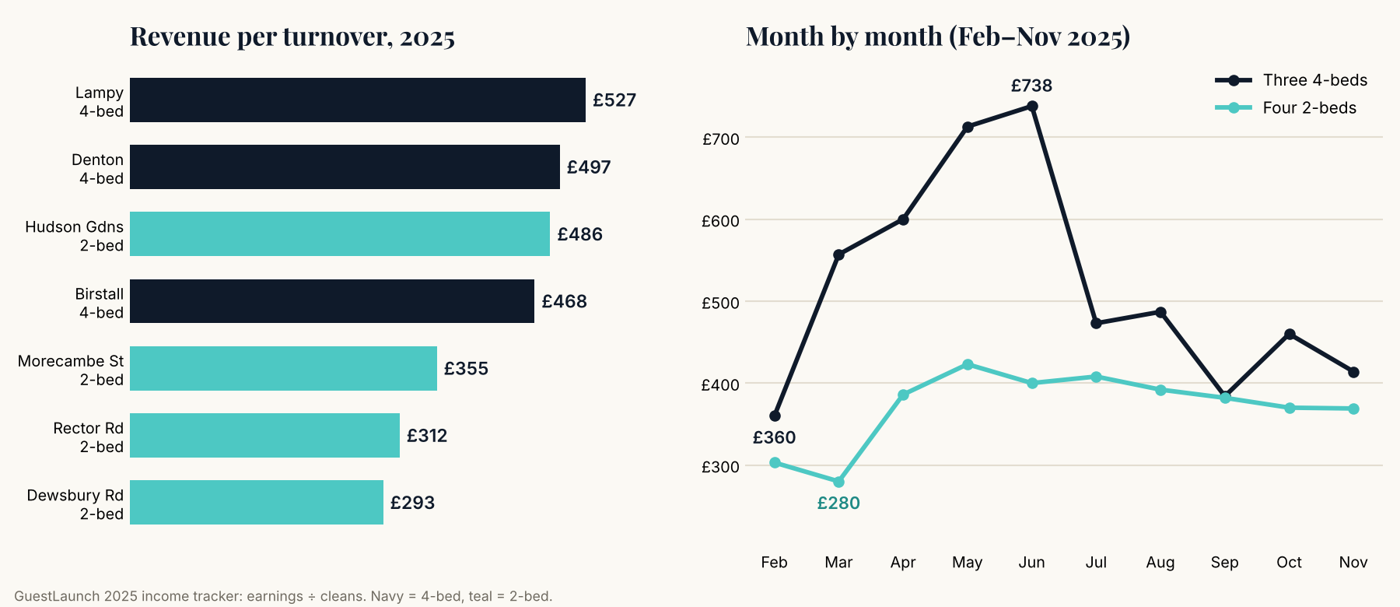
For the four-beds, June carries twice what February does (£738 against £360), and September is the weakest month after February at £384. For the two-beds the pattern is flatter, but March is the low at £280 and the group never gets above £423.
That fits something I found in one Sefton Park two-bed, where each turnover carried £639 from April to August and £362 from September to December, which I wrote up in the Sefton Park guide. Short autumn stays are not a mistake, but they do make each clean cost more of the income.
What I do with this
This is judgement, not data.
1. Work out your own number. Last twelve months' earnings divided by the number of turnovers. If you cannot get the turnover count from your booking system, count your cleaner's invoices. It takes ten minutes and most hosts have never done it.
2. Look at the weak months first. For our four-beds that is February and September; for our two-beds it is February and March. These are the months where a two-night weekend minimum earns the most, because it removes the one-night stay that carries the least. I would rather hold a rate and a minimum than discount into a pile of single-night changeovers, which is the argument I make in how to price a Liverpool Airbnb.
3. Do not chase longer stays blindly. A lower nightly rate to land a week can be a good trade or a bad one. Compare revenue per turnover before and after, not occupancy alone.
4. Audit your cleaning-fee settings. At our April 2026 audit, three of our 22 active listings showed a blank cleaning-fee field in the booking system even though real bookings carried a fee. A blank field is easy to miss and expensive if it is real. Check yours.
5. Check whether you are the right size for your own turnovers. If you self-manage, every changeover is also your time, which I weigh up in the honest maths on self-managing.
What this data is, and isn't
Figures come from our 2025 income tracker: monthly Airbnb earnings and clean counts for seven properties we have run through 2025, restricted to February to November so every property has data. Cleans stand in for turnovers (a deep clean or a re-clean after a complaint will inflate the count slightly), and the sets are small: three four-beds and four two-beds. These are one portfolio's numbers, not a Liverpool average, and the £80 cost in the illustration is an example, not what we pay.
Frequently asked
How much does it cost to clean an Airbnb in Liverpool? There is no single figure, because it depends on property size, laundry, and who does the cleaning. The cleaning fees currently set on our own listings range from £75 to £78 for two-beds and £90 for the four-beds we manage. Use your cleaner's actual invoice to work out your own cost per turnover.
What is revenue per turnover? Your earnings for a period divided by the number of cleans in that period. It shows how much income each guest changeover brings in. In our 2025 data it ran from £293 to £527 per turnover across seven properties.
How many turnovers does a Liverpool Airbnb have in a year? In our 2025 data, between 58 and 87 cleans across the seven properties in this post (Hudson Gardens and Dewsbury Road over eleven months, the rest over twelve). That is our portfolio, not a Liverpool average.
Should my cleaning fee cover my cleaning cost? It is a sensible starting point, but it is a guest-facing price as well as a cost recovery. Check that the fee in your booking system is actually set, and compare it with what each turnover really costs you, including laundry and restocking.
Does a minimum stay help with cleaning costs? It can. A two-night minimum on weekends removes the lowest-value single-night changeovers, which are the ones where the clean takes the biggest bite out of the income. Test it in your weakest months first and watch the first few bookings.
Not sure what each changeover is really costing you? We are owner-operated: I run eight properties myself and we manage sixteen, so you get a straight answer rather than a sales pitch. Get a free, honest valuation →
Or see how our Liverpool management works.
Sources: GuestLaunch 2025 income tracker (monthly Airbnb earnings and cleans, seven properties); cleaning fees as set in our booking system, checked April 2026. No external statistics are used. Guest and owner details are anonymised throughout.
Hero image is an AI-generated illustration, not one of our properties.