
I went looking for proof of something I have said out loud for two years: that a higher guest rating earns you more money.
Our own numbers do not show it. I think that is worth publishing anyway, because what they show instead is more useful to a Liverpool landlord than the thing I expected to find.
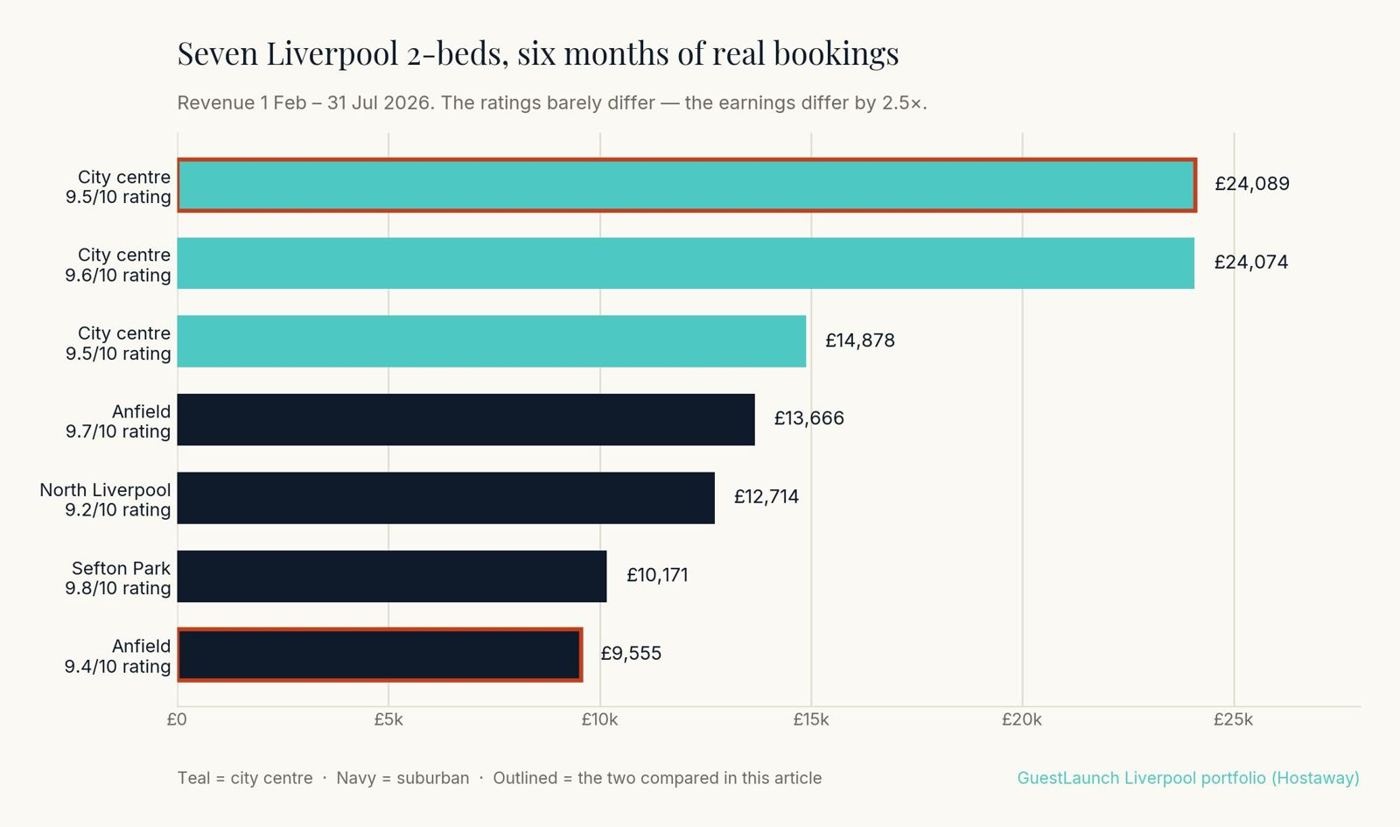
Here are two of our two-bedroom properties, six months of real bookings, February through July 2026.
| City-centre 2-bed | Anfield 2-bed | |
|---|---|---|
| Guest rating | 9.5 / 10 | 9.4 / 10 |
| Occupancy | 79% | 50% |
| Average nightly rate | £168 | £106 |
| Revenue, 6 months | £24,089 | £9,555 |
Same number of bedrooms. Same city. Ratings a rounding error apart. £14,534 between them.
The rating is not what separates them
I checked this properly rather than trusting the anecdote. Across nineteen established Liverpool listings — every property with at least twenty bookings in the window, so nothing half-onboarded is skewing it — I compared each one's guest rating against what it actually earned per night owned.
The correlation is −0.10. Statistically, that is nothing. Against occupancy alone it is −0.01, which is nothing twice over.
Our ratings run from 8.6 to 9.9 out of 10 — roughly 4.3 to 5.0 in Airbnb stars. Inside that band, going up does not move the money.
The individual cases are blunter than the average:
- Our highest-rated 2-bed — a 9.8 in the Sefton Park area, a genuinely lovely property — came sixth out of seven on earnings, at £10,171.
- Our lowest-rated house — an 8.6 — was the single biggest earner in its size class, at £30,072 over the same six months.
If rating were the lever, those two lines would be the other way round.
What is actually going on
Rating behaves like a threshold, not a dial.
Below about 4.6 stars, it is close to everything. Airbnb throttles your placement, you lose Superhost, and eventually the listing gets suppressed or removed. That is a cliff, and falling off it is catastrophic — which is exactly why our management agreement lets an owner walk if we hold their property below 4.5 for two months running. We put that clause in because the downside is real.
But every property in this comparison is already over the line. Once you are safely above it, the extra tenths stop buying you anything. Guests filtering Liverpool listings do not sort by 9.5 versus 9.8. They look at photos, price, location and whether there is parking.
So above the threshold, the money is made somewhere else entirely — and the six-month numbers say exactly where.
It is rate and occupancy, together. Look again at that first table. The city-centre flat did not win on one of them; it won on both — nearly thirty points more occupancy and sixty pounds more a night. That combination is the whole game, and it is what separates a good short-let from a mediocre one far more decisively than any review score.
The gap is biggest where you would least expect it
Here is the spread inside each of our size classes over the six months — the worst performer against the best.
| Size | Lowest | Highest | Gap |
|---|---|---|---|
| 2-bed | £9,555 | £24,089 | 2.5× |
| 3-bed | £6,421 | £17,731 | 2.8× |
| 4-bed | £19,187 | £30,293 | 1.6× |
| 6-bed | £22,469 | £30,072 | 1.3× |
GuestLaunch Liverpool portfolio, 1 February – 31 July 2026.
The small properties have the widest spread, and that surprises most owners. The instinct is that a big group house is the risky, variable asset and a little two-bed is the safe, boring one.
It is the reverse. A 6-bed in Liverpool sells to stag parties, football groups and big families, and there simply is not much competition — three of ours landed between £22,469 and £30,072, a tight and predictable band. A 2-bed competes with every other 2-bed in the city, plus the aparthotels, plus the Travelodge. That is where positioning decides everything, and where getting it wrong costs you more than half your income.
Where the city-centre premium actually comes from
Both of our top-earning 2-beds sit in the city centre. Both cleared just over £24,000 in six months. Neither is the prettiest flat we run.
What they have is walkable proximity to the things people come to Liverpool for — the arena on the Kings Dock, the ACC, the Ropewalks bars, Liverpool ONE, the waterfront. That location does two jobs at once: it fills midweek nights that a suburban property never sees, and it lets you charge event-weekend prices when the calendar turns. Occupancy and rate, from the same postcode.
An Anfield 2-bed has one demand driver, and it is spectacular but it is only about nineteen Saturdays a year. Between home games it is a quiet residential street, and the calendar shows it: 50% occupancy against 79% two miles away.
None of which means don't buy in Anfield. Our best-performing 4-bed is an Anfield house that cleared £30,293 — because a big house near the ground sells the matchday at a price a flat cannot touch. It means the strategy has to match the postcode, and the mistake is running a suburban property on city-centre assumptions, or vice versa.
What the whole portfolio did
For context, so you can benchmark your own:
- £394,651 in bookings across 28 Liverpool listings, 1 February – 31 July 2026.
- Established listings averaged 64% occupancy.
- Median nightly rate: £158.
If your Liverpool property is materially under 60% occupancy across a spring and summer, the problem is very unlikely to be your reviews.
The honest caveats
This is one operator's portfolio in one city over six months — 19 established properties, not 1,900. It is not a market study and I am not going to dress it up as one.
Two limits worth stating plainly. Our ratings only span 8.6 to 9.9, so this says nothing about what happens to a property sitting at 4.2 stars — I would expect that to be dire, and the threshold argument above says so. And rating is tangled up with property type: the highest-rated places tend to be the pretty suburban ones, which are also the lower-earning ones, so some of that mild negative number is really location wearing a rating's clothes.
What it does establish, for Liverpool, is that among properties that are already well-run, review score is not the variable that explains the income gap. Location, rate-setting and occupancy management are.
Frequently asked
How much does a 2-bed Airbnb earn in Liverpool? Across our portfolio, between £9,555 and £24,089 in the six months to 31 July 2026 — a 2.5× spread on identical bedroom counts. City-centre 2-beds sat at the top on roughly 79% occupancy and £168 a night; suburban ones came in near 50% and £106. Treat the top of that range as achievable with the right location and pricing, not as typical.
Does a higher Airbnb rating mean more money? Not above about 4.6 stars, on our numbers. Across nineteen established Liverpool listings the correlation between guest rating and revenue per available night was −0.10 — effectively zero. Below that threshold rating matters enormously, because Airbnb suppresses weak listings. Above it, rate and occupancy decide your income.
What is a good occupancy rate for a Liverpool short-let? Our established listings averaged 64% across February to July 2026, with the strongest city-centre properties near 80%. Under 60% over a spring and summer suggests a pricing or positioning problem worth looking at.
Is Liverpool city centre a better short-let investment than the suburbs? For a small flat, generally yes — it earns from both business midweek and event weekends. But our highest-earning 4-bed is in Anfield, near the ground. Bigger properties can win in the suburbs on group and matchday demand; small ones usually cannot.
Why do smaller properties have such a wide earnings range? Because they compete with everything — every other flat, every aparthotel, every budget hotel room. Large group houses have far fewer direct competitors in Liverpool, so their results cluster. Our 6-beds varied by 1.3×; our 3-beds by 2.8×.
The bottom line
I set out to prove that ratings drive revenue and our own data politely declined. The nearly £15,000 sitting between two well-reviewed Liverpool 2-beds was not built out of review scores. It was built out of where they are and what they charge, every single night, for six months.
Protect your rating like the threshold it is — fall through it and nothing else matters. Then go and win on the two numbers that actually move: what you charge, and how often it sells.
Want to know which side of that £14,534 your property is on? Send us your postcode and bedroom count and we'll benchmark it against real bookings from our Liverpool portfolio, free, same day.
GuestLaunch, Liverpool short-let management. We only earn when you earn.
Source: GuestLaunch portfolio data (Hostaway), pulled 19 August 2026. Window 1 February – 31 July 2026, 181 nights. Revenue is confirmed and modified reservations, pro-rated to nights falling inside the window; cancellations, inquiries and owner stays excluded. "Established" means at least 20 bookings in the window (19 listings). Correlations are Pearson coefficients across those 19 listings. Ratings are Hostaway average guest review scores out of 10; star equivalents are approximate. Individual properties are described by area and type only.
Internal links: Airbnb Management Liverpool (pillar) · Airbnb Management City Centre · Airbnb Management Anfield · Dynamic Pricing service.