Ask a Liverpool landlord which property earns the most and they will point at the biggest house. Ask which earns the most per bedroom and the answer flips. Between April and November 2025, our five two-beds averaged £1,277 per bedroom per month. Our four four-beds averaged £876. The one six-bed we ran all that period averaged £612.
The big houses still take more money in total. A four-bed brought in £3,502 a month on average, against £2,554 for a two-bed. But that is 37% more income for 100% more bedrooms, and I would not have guessed the gap would be that wide before I lined the numbers up.
Here is what the figures show, where the picture is messier than the headline, and what I would do with it if I were buying or pricing a Liverpool short-let.
The numbers: April to November 2025
I used April to November because that is the window where ten properties we ran through 2025 all have a full set of monthly earnings. Every property below has all eight months, none are part-years.
| Property type | Properties | Avg monthly revenue | Per bedroom | Revenue per turnover |
|---|---|---|---|---|
| 2-bed | 5 | £2,554 | £1,277 | £405 |
| 4-bed | 4 | £3,502 | £876 | £507 |
| 6-bed | 1 | £3,669 | £612 | £612 |
"Revenue per turnover" is earnings divided by the number of cleans recorded, the same measure I used in the cleaning-cost post.
 Average monthly revenue by property type, April–November 2025. Left: per bedroom. Right: whole property.
My reading of why: a well-located place for two to four people is easy to sell, and a small property is easier to fill on an ordinary Tuesday than a house that needs a group. A six-bed needs a large party before it earns anything like its potential, and those parties book on their own timetable.
It is not one flat's fluke
The obvious objection is that one standout two-bed is carrying the average. There is one: a city-centre flat averaged £3,907 a month, higher than any of our four-beds.
So I took it out. The other four two-beds averaged £2,215 a month, or £1,107 per bedroom. That is still 26% above the four-beds' £876. The finding survives the best flat being removed, which is why I trust it.
Where it does not survive is the range. Our five two-beds ran from £1,928 to £3,907 a month. That is a two-to-one spread between the weakest and strongest, for the same number of bedrooms:
| 2-bed | Average per month, Apr–Nov | Per bedroom |
|---|---|---|
| City centre | £3,907 | £1,954 |
| Sefton Park | £2,341 | £1,171 |
| Anfield side | £2,504 | £1,252 |
| Everton side | £2,088 | £1,044 |
| Anfield side (second) | £1,928 | £964 |
Location and the way a flat is run matter more than the label "two-bed". The weakest two-bed in the set still earned £964 per bedroom, above the average four-bed, but only just.
The four-beds are a spring business
Here is the part that changes how I price. Our four-beds and our two-beds do not have the same shape across the year.
For the four-beds, April to June averaged £4,248 a month. September to November averaged £2,922, a fall of 31%. For the two-beds, April to June averaged £2,579 and September to November £2,648, up 3%.
So the two-bed behaves like an all-rounder and the four-bed behaves like a seasonal asset: very strong in spring and early summer, then noticeably weaker as autumn arrives. My reading is that group houses lean on group trips and events, and those cluster in spring and summer. I wrote about the timing side of this in how to price a Liverpool Airbnb.
One more data point on stability. Across our two-bed property-months, 10 of 40 fell below £2,000. For the four-beds it was 1 of 32. For the six-bed it was 0 of 8. The large properties' lows are higher, even if their highs swing further.
So which is the better buy?
This is judgement, not data, and I want to be careful: revenue is not profit. A four-bed has more rooms to clean, more linen and more to maintain, and a mortgage or rent that is usually much bigger than a two-bed's. I have not put costs in these tables on purpose.
What I take from the numbers:
- Per pound of property, small wins. If you are choosing where to put a fixed budget, two-beds in a good location have given us more revenue per bedroom, and a steadier year.
- Per property, large wins. If your constraint is the number of properties you can manage, a four-bed brings in about £950 a month more than a two-bed on average, and each turnover carries more money.
- Size is not the decision, location is. The gap between our best and worst two-bed is bigger than the gap between the average two-bed and the average four-bed.
- Match the strategy to the property. For a four-bed, hold your spring prices and plan an autumn offer. For a two-bed, keep it simple and steady. I go through the neighbourhood side in the city-centre two-bed guide and the Sefton Park guide.
What this data is, and isn't
All figures come from our own 2025 income tracker: monthly booking revenue for ten properties, April to November 2025. The two-beds and the six-bed use the tracker's Airbnb and Booking.com earnings columns; the four-beds use its single "Earnings" column. I have used them as recorded and not adjusted them. Revenue is before management fees, cleaning, rent and bills.
It is a small sample: five two-beds, four four-beds and one six-bed, so treat the six-bed figure as an example rather than a rule. These are one portfolio's numbers, not a Liverpool average, and 2025 was a single year. Property details are anonymised.
Frequently asked
Is a 2-bed or a 4-bed better for Airbnb in Liverpool? In our 2025 numbers, two-beds earned more per bedroom (£1,277 against £876 a month) and held up better in autumn, while four-beds earned more in total (£3,502 against £2,554). Which is better depends on your budget, costs and how many properties you can manage.
How much does a Liverpool Airbnb earn per month? Across the ten properties in this post, average monthly revenue between April and November 2025 ranged from £1,928 to £3,907 for two-beds and £2,771 to £3,808 for four-beds. Those are our figures before fees and costs, not a Liverpool average.
Why do four-beds earn less in autumn? Our four-beds averaged £4,248 a month in April to June and £2,922 in September to November. Group houses lean on group trips and big events, which in our experience cluster in spring and summer.
Is a 6-bed worth it for short-lets? Our one six-bed averaged £3,669 a month, the highest total but the lowest per bedroom at £612. With one property in the sample I would not generalise; check how often you can realistically fill six bedrooms.
Does location matter more than size? In our data, yes. The spread between our best and weakest two-bed (£3,907 against £1,928 a month) was bigger than the gap between the average two-bed and the average four-bed.
Not sure whether your property is a two-bed type or a four-bed type of earner? We are owner-operated: I run eight properties myself and we manage sixteen, so you get a straight answer rather than a sales pitch. Get a free, honest valuation →
Or see how our Liverpool management works.
Sources: GuestLaunch 2025 income tracker (monthly earnings, ten properties, April–November 2025). No external statistics are used. Guest and owner details are anonymised throughout.
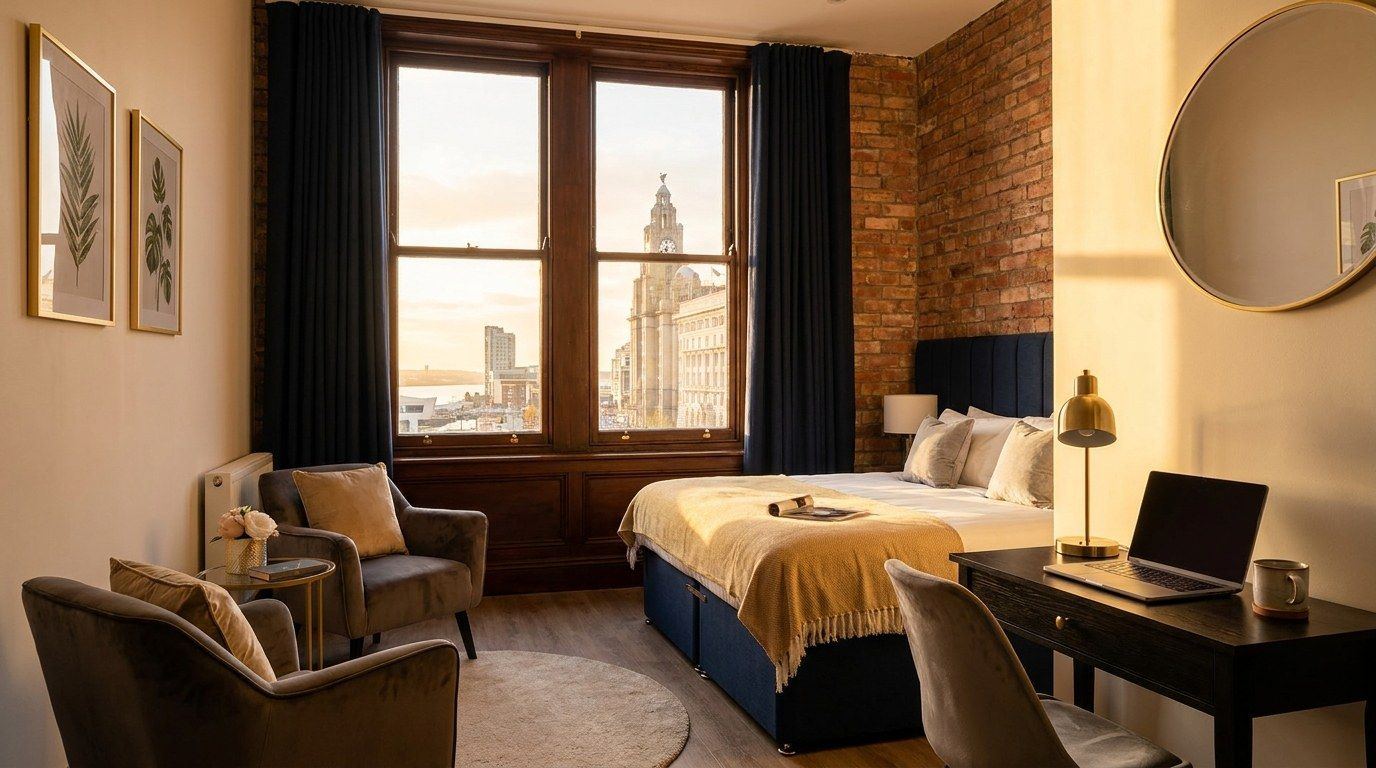
Hero image is an AI-generated illustration, not one of our properties.